

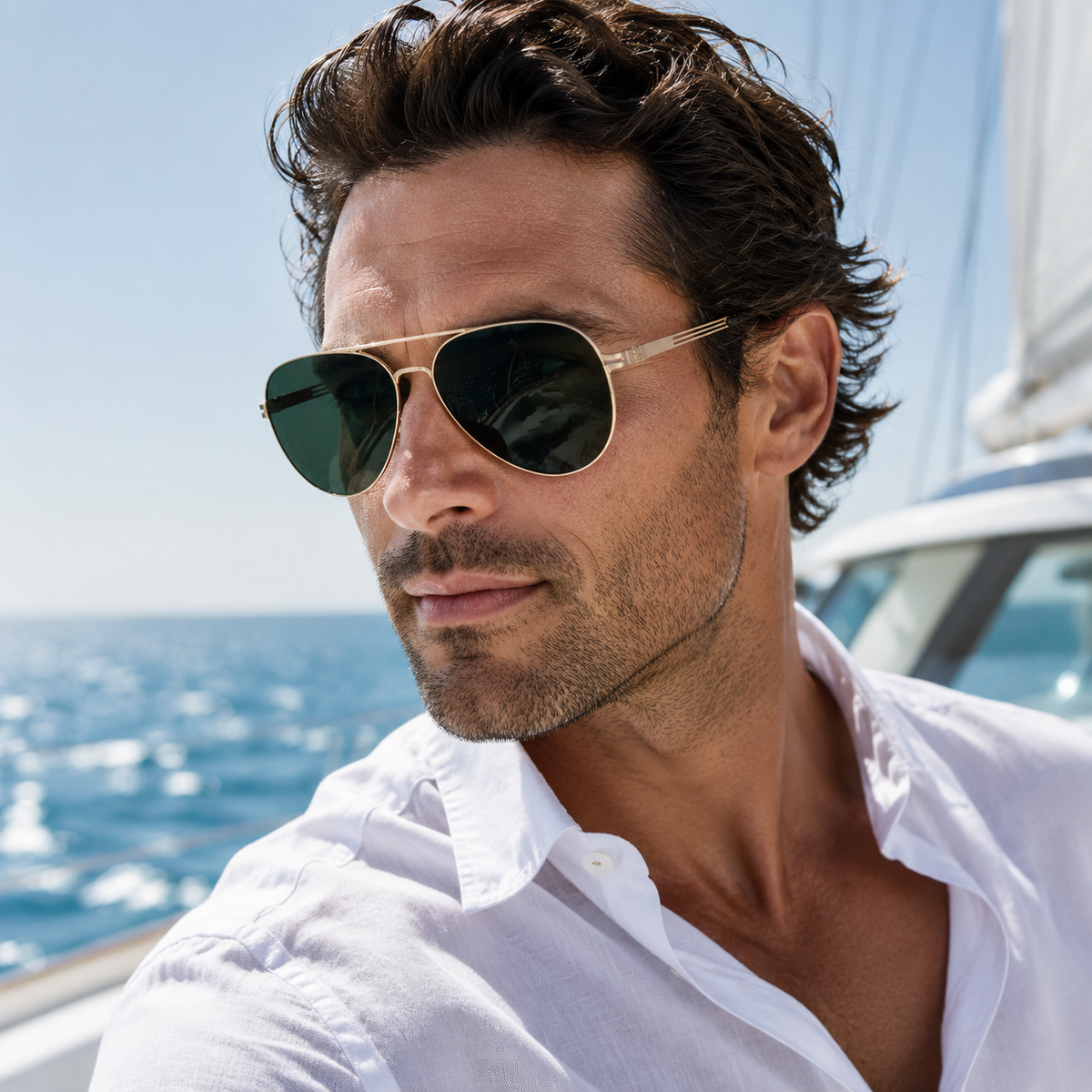
Short answer: yes, for daytime driving. Polarized lenses remove the horizontally reflected light that comes off wet asphalt, painted bonnets and the windscreens of oncoming cars, which is the glare responsible for most of the squinting and eye strain on a long drive. There are three situations where they are the wrong choice: at night, in a category 4 tint, and in a car whose dashboard or head-up display washes out through a polarizing filter. The last of those is worth testing in your own car before you buy.
The rest of this guide explains why, and what to look for in a pair you will actually keep in the car.
What polarization actually removes
Sunlight travels in every orientation at once. When it strikes a flat horizontal surface, a wet road, a bonnet, the surface of water, most of it bounces back oriented in one direction: horizontally. That concentrated horizontal band is what your eye reads as glare.
A polarized lens holds a vertical filter that blocks that band and lets the rest of the light through. The reflected glare drops sharply while the rest of the scene stays close to its normal brightness.
This is the part most buyers get wrong. A dark lens dims everything equally, including the road sign you are trying to read. A polarized lens removes one specific kind of light and leaves the rest alone. They are different jobs, and a darker tint is not a substitute for polarization.
Where polarized lenses earn their place on the road
- Wet asphalt after rain. A wet road reflects the sky back at you as a single sheet of white light. This is the condition where the difference is most obvious.
- Low morning and late afternoon sun. When the sun sits at windscreen height, it is reflecting off every flat surface ahead of you at the same time.
- Bonnet and dashboard reflections. A light-coloured dashboard reflects up into the inside of the windscreen and sits as a ghost image over the road. Polarization cuts what reaches your eye.
- Oncoming traffic. Sunlight flashing off chrome, wing mirrors and other windscreens arrives as short, sharp bursts that force a blink at the worst moment.
- Snow, sand and salted winter roads. Reflected light off a bright surface at eye level is the hardest glare to tolerate without a filter.
There is also the cumulative effect. Glare does not just make a moment uncomfortable, it makes you squint, and squinting for three hours leaves you tired in a way that most drivers only notice once they stop doing it.
The three real drawbacks
Any honest guide has to cover these, because they are the reason some drivers go back to non-polarized lenses.
1. Screens can dim or blank out
LCD panels have their own polarizing filter built in. When the axis of your lens lines up against the axis of the screen, the display darkens, shifts colour, or goes black at certain head angles. This affects digital instrument clusters, large centre infotainment screens, head-up displays and phones mounted for navigation. The FAA gives pilots the same warning about cockpit displays.
It is not universal, and it depends on the car and the lens. Test it: sit in the driver's seat, put the sunglasses on, and tilt your head left and right while looking at every screen you rely on.
2. Faint patterns in side and rear glass
Side and rear windows are tempered glass. The heat-treating process leaves internal stress patterns that are invisible to the naked eye but appear as faint blotches or stripes through a polarized lens. It is harmless, and most people stop noticing within a week, but it catches first-time wearers off guard.
3. Night driving
No sunglass belongs on a night drive, polarized or otherwise. Every tint reduces the light reaching your eye at the exact moment you need all of it. Yellow lenses marketed for night driving do not solve this either; the evidence does not support a benefit, and some studies point to slower reaction times.
Polarized and UV400 are not the same thing
This is the most common confusion in the category, and it matters more in a car than anywhere else.
Polarization is a comfort and contrast feature. UV400 is a protection standard: the lens blocks ultraviolet light up to 400 nanometres, which covers the full UVA and UVB range. A lens can be polarized without being UV400, and it can be very dark without being either. Confirm both separately.
Why it matters behind the wheel: windscreens are laminated glass and block UVA well, averaging around 96% in a JAMA Ophthalmology study of 29 cars. Side windows are tempered glass, and they block far less, averaging 71% with a range from 44% to 96% across the same sample. That research links the gap to the higher rates of cataract in left eyes and left-side facial skin cancer recorded among drivers in countries where the driver sits on the left.
In practice: the side of your face nearest the window takes more UVA than the rest of you, every month of the year, through cloud and through winter sun. A closed window is not eye protection.
Every Elliot Vaughn frame carries UV400 lens protection as standard.
How dark should a driving lens be?
Sunglass lenses are graded from category 0 to category 4 under EN ISO 12312-1, based on how much visible light they transmit.
| Category | Light transmitted | Suitable for driving |
|---|---|---|
| 0 to 1 | 43% to 100% | Overcast and dusk only, too light for bright sun |
| 2 | 18% to 43% | Yes, good for variable and shaded roads |
| 3 | 8% to 18% | Yes, the standard choice for bright daytime driving |
| 4 | 3% to 8% | No. Built for glaciers and high altitude |
Category 4 lenses are not legal for driving across the EU and are restricted in many other jurisdictions. They should carry a "not suitable for driving" label. If a pair is described as extremely dark or made for extreme brightness, check before you take it near a car.
A simple test that needs no labels: if you cannot read your instrument cluster clearly when you pull into a covered car park, the lens is too dark for the road.
Grey, brown or green
- Grey. Neutral. It dims everything by the same amount and leaves colour relationships intact, which is what you want when you are reading brake lights and traffic signals. The safest default for driving.
- Brown and amber. Lifts contrast and depth perception in haze and flat light, at the cost of a warm colour shift. Well suited to long motorway drives in changeable weather. Some drivers never adjust to the shift.
- Green. Sits between the two, with slightly more contrast than grey and less colour shift than brown.
-
Avoid. Yellow and orange in bright sun, since they are low-light lenses and produce uncomfortable brightness in direct light. Avoid any strong novelty tint that changes how red and green read.

Weight and fit matter more in a car than in a shop
A frame you try on for twenty minutes and a frame you wear for four hours are judged by completely different standards. Three things decide whether a pair is still comfortable at hour three.
Weight. Under 25 grams is roughly where most people stop registering that the frame is there. Metal aviators are often heavier than they look, because a thick stainless front carries its weight forward onto the nose. The Brenta Polarized Aviator weighs 22 g.
Nose pads. Adjustable silicone pads do work that a moulded bridge cannot. They let the frame sit at the right height for your nose, and they hold position when it is hot. A car in summer is a hot, humid environment, and a bridge that slides down the nose is the most common comfort complaint drivers raise about a frame that felt fine indoors.
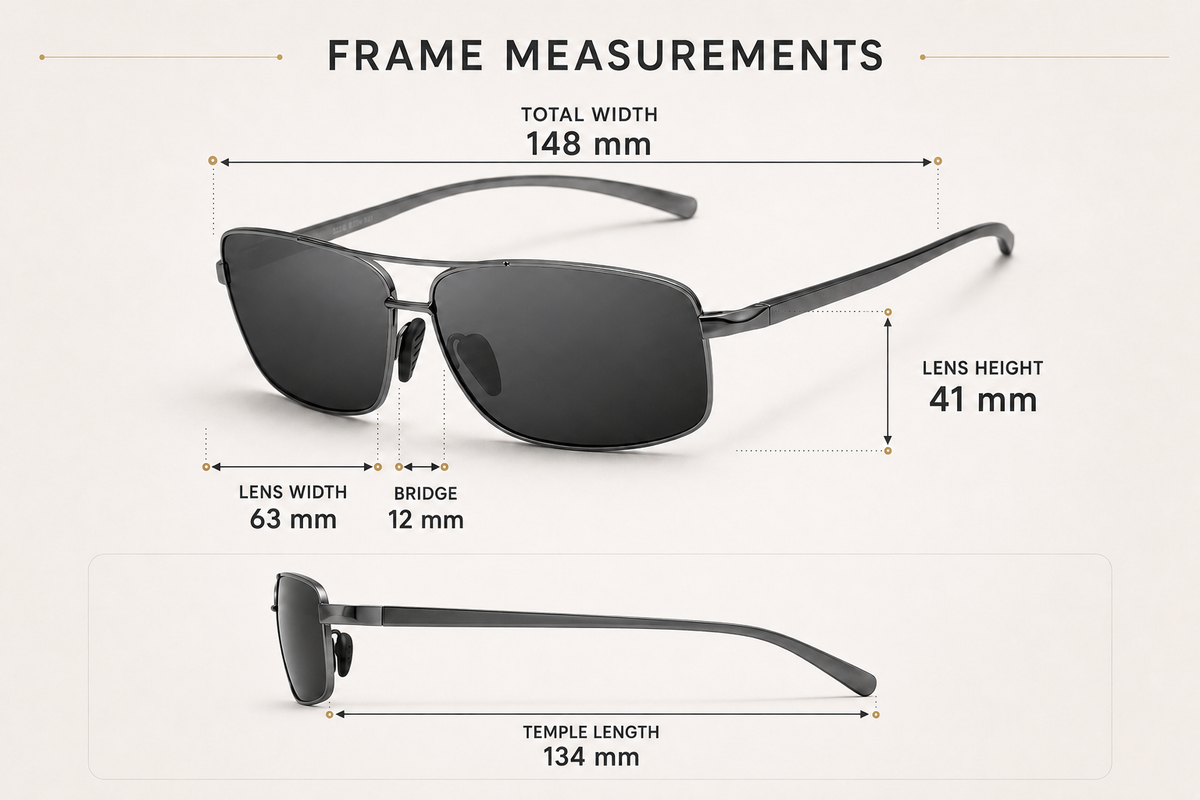
Width and temple length. Too narrow and the frame presses at the temples after an hour. Too wide and it shifts every time you check a mirror. Elliot Vaughn publishes total width, lens width, lens height, bridge width and temple length on every product page, so you can measure a pair you already own and compare before ordering. The Brenta measures 146 mm across the front with 146 mm temples, which suits a medium to wide face.
Lens height is worth a mention on its own. When the sun is low, coverage above and below the eye is what keeps light from creeping in around the frame. The Brenta's lens stands 52 mm tall, which covers the eye socket properly at the angles that matter on a morning commute.
A five-point check before you drive in a new pair
- Confirm the lens is polarized and UV400, stated separately.
- Check the lens category is 3 or lower. Nothing labelled category 4.
- Sit in your car and look at every screen you use, tilting your head each way.
- Check the frame holds position when you look down at the centre console and back up.
- Keep them in the car. The pair you have with you is the one that helps.
Elliot Vaughn polarized frames for driving
The Brenta Polarized Aviator was drawn with the road in mind. A stainless-steel aviator front carries polarized UV400 lenses, and the whole frame comes in at 22 g. Adjustable silicone nose pads and coated temple tips hold it in place through a long drive, and a precision stacked hinge and sculpted, cut-out temples give it a technical finish that stays quiet. It is a unisex frame, available in gold, gunmetal, black and grey finishes.
The full polarized collection covers four frames, each with polarized lenses and UV400 protection:
| Frame | Shape | Notes |
|---|---|---|
| Brenta Polarized Aviator | Aviator | Stainless steel, 22 g, adjustable silicone nose pads |
| Modena Polarized Aviator | Aviator | Wider colour range, warmer finishes |
| Cavaro Polarized | Metal | Understated metal build in four finishes |
| Novara Polarized | Metal | The slimmest profile of the four |
Browse the rest of the range in men's sunglasses and women's sunglasses. Every pair ships in a turquoise hard case with a microfiber cloth, and returns stay open for 30 days.
Frequently asked questions
Are polarized sunglasses good for driving? Yes, for daytime driving. They remove reflected glare from wet roads, bonnets and other windscreens, which reduces squinting and eye fatigue on longer drives. They are not suitable at night, and they are not suitable in a category 4 tint.
Are polarized sunglasses legal for driving? Polarization itself is not restricted anywhere. What is restricted is lens darkness. Category 4 lenses are not permitted for driving across the EU and are restricted elsewhere. Categories 0 to 3 are accepted for daytime driving in effectively all jurisdictions.
Will polarized lenses stop me reading my dashboard? Sometimes, depending on the car and the lens. LCD screens carry their own polarizing filter, and at certain angles the two can cancel each other out. Test any pair against your own instrument cluster, centre screen and head-up display before you rely on them.
Do I still need sunglasses if my windscreen blocks UV? Yes. Laminated windscreens block UVA well, but the side windows beside you are tempered glass and block far less, averaging around 71%. The driver's side of the face takes more UVA than the rest of the body, year round.
Are polarized sunglasses good for night driving? No. No sunglass is. Any tint reduces the light reaching your eye when you need the most of it. Yellow lenses sold as night driving glasses do not solve the problem either.
Polarized or UV400: which matters more? They answer different questions. UV400 is protection and should be non-negotiable. Polarization is comfort and clarity, and it is the feature that changes how a bright road looks. Look for both on the same lens.

Leave a comment
This site is protected by hCaptcha and the hCaptcha Privacy Policy and Terms of Service apply.