

Most sunglasses that get returned are not disliked. They are the wrong size. The shape was right, the colour was right, and then they slid down the nose, pressed at the temples, or sat on the cheekbones.
The problem is that eyewear sizing is published in a format almost nobody explains: five numbers in millimetres, printed inside a temple arm in type too small to read without the glasses you are not wearing. Once you can read those numbers, buying eyewear online becomes about as risky as buying a shirt in a size you already know.
This guide covers what each measurement means, how to find your own size in about five minutes, and how to tell whether a frame actually fits once it arrives.

Start here: the number that matters most
If you only take one thing from this page, take this one.
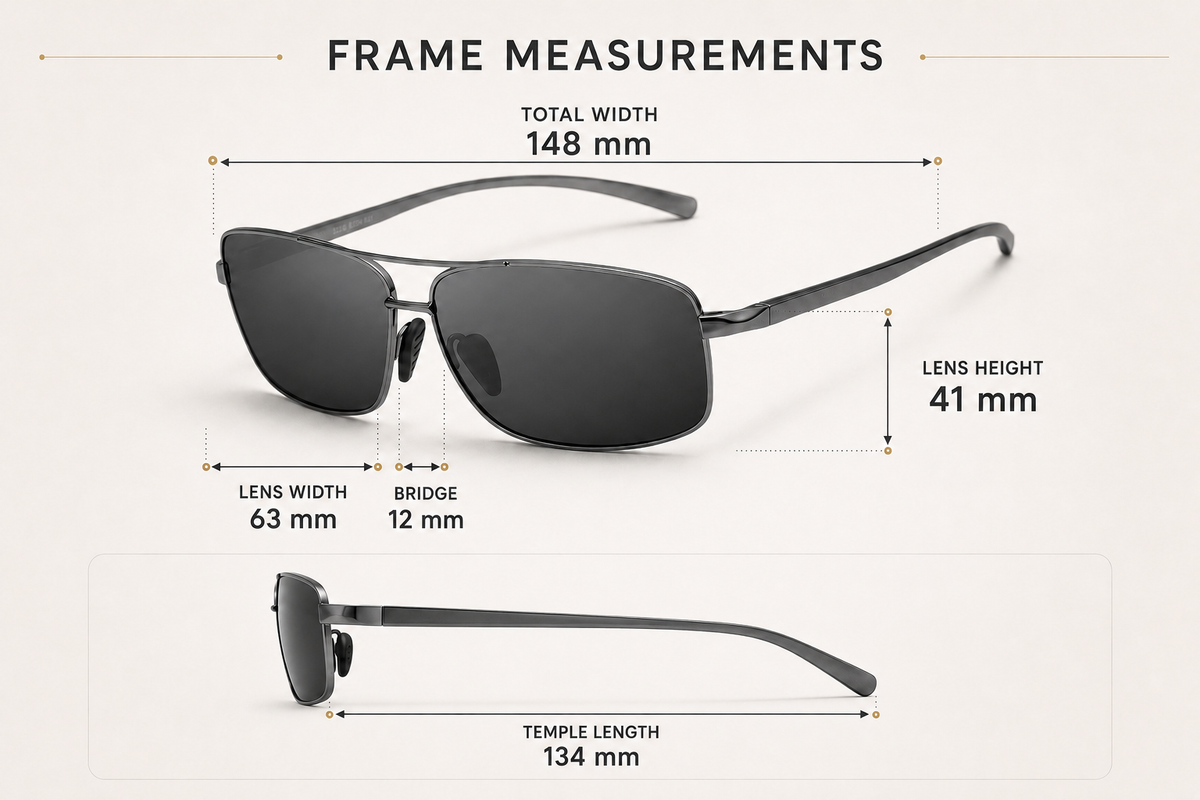
Total frame width is the measurement that decides whether a pair fits. It is the distance across the front of the frame, hinge to hinge, and it should be close to the width of your face at the temples.
Get it right and everything else has room to work. Get it wrong and no amount of adjustment saves the frame. Too narrow and it grips the sides of your head and leaves marks. Too wide and it slides forward every time you look down, and light comes in around the edges.
Lens width gets quoted far more often because it is the first number in the standard sizing code, but on its own it tells you very little. A 55 mm lens on a wide bridge and a 55 mm lens on a narrow bridge produce frames that fit two different faces.
The five measurements, explained
| Measurement | What it is | Typical range | What goes wrong |
|---|---|---|---|
| Lens width | Horizontal width of one lens at its widest point | 40 to 62 mm | Eyes sit off-centre in the lens |
| Bridge width | Gap between the two lenses, the part that spans your nose | 14 to 24 mm | The frame slides, or pinches |
| Temple length | Hinge to the end of the arm, following the bend | 120 to 150 mm | Pressure behind the ears, or slipping |
| Lens height | Vertical height of one lens | 30 to 55 mm | Frame rests on the cheeks, or leaves gaps |
| Total frame width | Full width across the front, hinge to hinge | 125 to 150 mm | The fit fails outright |
Lens width, bridge width and temple length are the three printed inside most frames, in that order. You will see them written as 59-17-146 or 59□17 146. The small square is a boxing-system mark and it means the same thing as a dash.
Lens height and total frame width are not usually printed anywhere on the frame, which is why they need to come from the product page. They are also the two that matter most for comfort, so their absence on a listing is worth noticing.
How to read the numbers on the pair you own
Take a pair you like and look at the inside of the left temple arm, near the hinge. On acetate frames the code is usually printed in white or silver. On metal frames it may be etched on the bridge instead, between the lenses.
You are looking for three numbers, sometimes preceded by a model name and colour code:
EV 1046 59□17 146
That reads as a 59 mm lens, a 17 mm bridge and a 146 mm temple. Those are the Brenta's numbers, as it happens.
If you cannot find a code, the frame may not carry one. Older or unbranded frames often do not. In that case, measure it yourself with a ruler: lay the frame flat, measure across one lens at its widest point, then measure the gap between the lenses at the narrowest point.
Finding your size in five minutes
Method 1: copy a frame that already works
This is the most reliable approach, and it takes about a minute.
Find a pair you own that fits well, read the code inside the temple, and then shop within these tolerances:
- Lens width: within 2 mm
- Bridge width: within 1 mm
- Temple length: within 5 mm
Stay inside those and a new frame will feel familiar. The bridge is the tightest tolerance because it does the most work, and 2 mm on a bridge is the difference between a frame that sits and a frame that creeps down your nose.
Method 2: measure your face
If you have no reference pair, measure the face directly.
Stand in front of a mirror with a ruler held horizontally across your face, at eye level. Measure the distance between the two points where the sides of your head meet your temples, roughly in line with the outer corners of your eyes. That figure is your face width.
For a more accurate result, use a payment card. Every card is 85.6 mm wide as a matter of standard. Hold one flat against your forehead, take a photo straight on, then measure both the card and your face width in the image and scale up. It is the same principle optical apps use, and it removes the mirror-reversal error.
Then match:
| Your face width | Look for a total frame width of |
|---|---|
| Under 130 mm | 125 to 132 mm (narrow) |
| 130 to 140 mm | 132 to 142 mm (medium) |
| Over 140 mm | 142 to 150 mm (wide) |
A small overhang is fine and often looks better. A frame that finishes noticeably inside the edges of your face reads as too small, and one that extends well past reads as borrowed.
Seven checks that tell you a frame fits
When the frame arrives, work through these in front of a mirror. It takes two minutes and it is more reliable than deciding by photograph.
- Width. The hinges sit at or just outside the outer corners of your eyes, and the frame front is roughly as wide as your face.
- Eye position. Your eyes sit centred left to right in each lens, and slightly above the vertical centre.
- Brow line. The top rim sits at or just below your eyebrows without cutting across them, unless the design carries a deliberate brow bar.
- Cheeks. Smile fully. The bottom rim should not touch your cheeks. If it does, the frame will lift every time you speak and it will collect makeup and skin oil.
- Temples. The arms run straight back from the hinge and touch the side of your head only lightly, until just before the ear.
- Ears. The bend in the temple sits at the top of the ear, not in front of it or behind it, and the arm follows the curve without pressing.
- The nod test. Look down at your shoes. The frame should stay where it is. Any slide means the bridge or the temples are wrong.
Six out of seven is usually adjustable. Fail the first check and the frame is the wrong size.
The bridge is where online purchases go wrong
Width failures are obvious in a photograph. Bridge failures are not, and they cause most of the quiet disappointment in online eyewear.
The bridge carries most of the frame's weight, and noses vary far more than the industry admits. A low nose bridge, a wide nose bridge, high cheekbones, or a combination of all three will defeat a frame that fits perfectly across the face.
The signs are specific:
- The frame slides down within minutes of putting it on
- Your eyelashes brush the inside of the lenses
- The bottom rim rests on your cheeks even though the lens height looks reasonable
- Red marks appear on either side of the nose after an hour
Fixed bridges are moulded into the frame front, common on acetate, and they fit exactly one nose shape. When they suit you they are comfortable and stable, and when they do not there is nothing to be done.
Adjustable nose pads sit on small metal arms and can be bent inwards, outwards, up or down. They are the reason metal frames fit a wider range of faces, and they let you raise a frame off the cheekbones or narrow it to stop a slide. If you have ever struggled with frames sliding, look for pads.
Recommended for adjustable fit
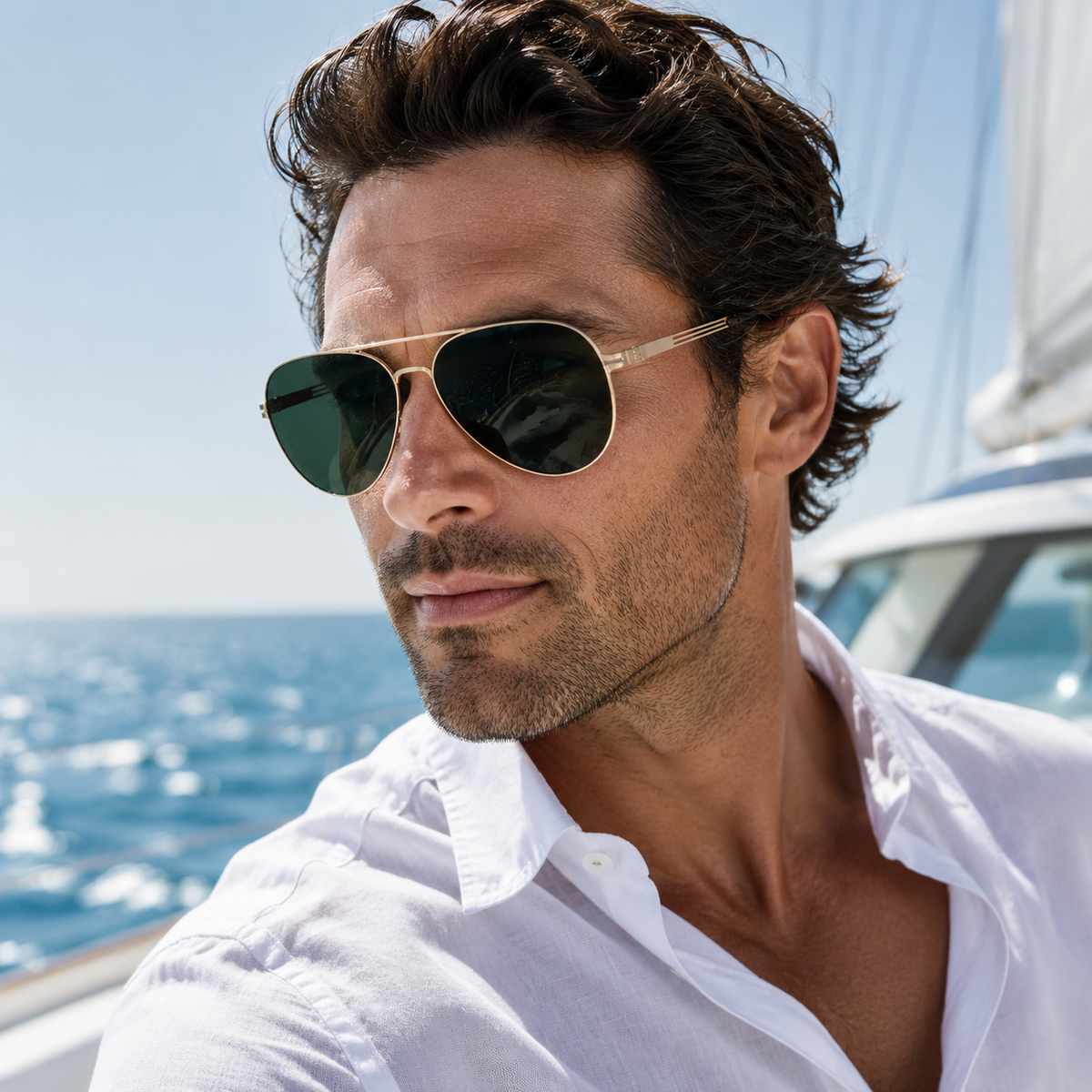
A stainless-steel aviator with adjustable silicone nose pads and coated temple tips, so the bridge height can be set rather than accepted. 59 mm lens, 17 mm bridge, 146 mm across the front, 146 mm temples, 22 g. The width suits a medium to wide face, and the 52 mm lens height gives full coverage when the sun sits low.

Temple length and the pressure test
Temple length is measured from the hinge to the tip, following the bend rather than in a straight line. Most adult frames are 140, 145 or 150 mm.
Too short and the bend sits in front of your ear, which pushes the frame forward and creates a pressure point behind the ear that gets worse over a long day.
Too long and the bend sits behind the ear with nothing to hook onto, so the frame relies entirely on the bridge and slides forward when you look down.
The useful part: temple length is the easiest measurement to adjust after purchase. Metal arms can be re-bent, and acetate arms can be warmed and reshaped. Any optician will do it in a few minutes, usually at no charge. Width and bridge cannot be changed this way, which is why they deserve the attention up front.
How each shape should sit
Aviators. The teardrop should cover from just under the brow to the top of the cheekbone. The double bridge sits level across the nose rather than tilted. Aviators run large by design, so the common error is going a size up on a frame that was already generous.
Cat-eye. The outer corners should lift above the line of the brow at the outer edge, which is the whole point of the shape. Too wide and the flick lands past the edge of the face and loses the lift. Cat-eyes are among the more forgiving shapes on width and among the least forgiving on lens height.
Recommended for narrow to medium faces
Sculpted lower rims and slim cutout temples keep the front light and close to the face, so the outer corners lift where they should instead of sitting wide. The frame's best seller, and the shape most people find easiest to wear.

Square and rectangle. Total width does almost all the work here, because the flat top and bottom lines make any overhang obvious. Check the brow line carefully.
Round. Lens diameter matters more than total width. A round lens that is too large drops onto the cheeks quickly, since a circle gains height as fast as it gains width.
Rimless. The least forgiving of all on bridge fit, because there is no rim to distribute pressure and no frame front to hide a poor sit. Measure carefully before buying rimless online.
What changes with optical frames
Sunglasses tolerate a few millimetres of error. Prescription frames tolerate fewer, because the lens has an optical centre and your pupil needs to sit at it.
Three differences worth knowing:
- Pupillary distance matters. Your PD determines where the optical centre lands. A frame much wider than your face pushes the centres outward and can cause eye strain, particularly on stronger prescriptions.
- Lens height sets what you can wear. Progressive lenses need vertical room for the distance, intermediate and reading zones. Below roughly 30 mm of lens height, progressives become difficult to fit.
- Smaller lenses mean thinner edges. On a strong prescription, a smaller lens keeps the edge thickness down. This is one case where sizing down has a real optical benefit rather than an aesthetic one.
The optical eyewear collection covers round and titanium frames in the same restrained language as the sunglasses range. Titanium is worth a mention on fit specifically: it is light enough that bridge pressure drops noticeably, and the pad arms hold an adjustment well.
Quick diagnosis: what your frame is telling you
| What you notice | Likely cause | What to change |
|---|---|---|
| Slides down your nose | Bridge too wide, or temples too long | Narrower bridge, or adjustable pads |
| Pinches at the temples | Frame front too narrow | Add 4 to 6 mm total width |
| Rests on your cheeks | Lens height too tall, or bridge too low | Shorter lens, or raise the pads |
| Lashes touch the lenses | Bridge sitting too low | Raise the pads, or a taller bridge |
| Red marks behind the ears | Temples too short | Longer temples, or have them re-bent |
| Frame edge visible in your side vision | Frame too narrow for your face | Wider frame front |
| Light coming in at the sides | Frame too wide, or too flat in curve | Narrower frame, or more wrap |
| Marks either side of the nose | Pads set too narrow | Bend the pads outward slightly |
Most of these have a fix. The two that usually do not are a frame front that is genuinely too narrow and a fixed bridge that does not match your nose.
Frequently asked questions
What do the numbers on sunglasses mean? Three numbers printed inside the temple arm: lens width, bridge width and temple length, all in millimetres. A frame marked 59-17-146 has a 59 mm lens, a 17 mm bridge and 146 mm temples. Lens height and total frame width are not usually printed and need to come from the product listing.
How wide should sunglasses be? The frame front should be roughly as wide as your face at the temples, with the hinges at or just outside the outer corners of your eyes. As a guide, under 130 mm of face width suits a 125 to 132 mm frame, 130 to 140 mm suits 132 to 142 mm, and over 140 mm suits 142 to 150 mm.
Should sunglasses touch your cheeks? No. Smile fully and check. Contact with the cheeks means the frame will lift when you talk, and it will pick up skin oil and makeup on the lower rim.
How do I know my sunglasses size without measuring my face? Read the code inside a pair that already fits and shop within 2 mm on lens width, 1 mm on bridge and 5 mm on temple length. It is faster and more accurate than measuring a face.
Can sunglasses be adjusted after buying? Temple arms and nose pads can be adjusted, usually free at any optician. Frame front width and a fixed moulded bridge cannot be meaningfully changed, so those are the two to get right before ordering.
Do sunglasses loosen over time? Metal frames and pad arms gradually spread with wear, which is normal and reversible with a small adjustment. Acetate frames soften slightly in heat, which is why leaving a pair on a dashboard in summer is worth avoiding.
Browse the full range in men's sunglasses, women's sunglasses and optical eyewear. Every order ships in a turquoise hard case with a microfiber cloth, and returns stay open for 30 days, so a frame that does not sit right can go back.

Leave a comment
This site is protected by hCaptcha and the hCaptcha Privacy Policy and Terms of Service apply.