

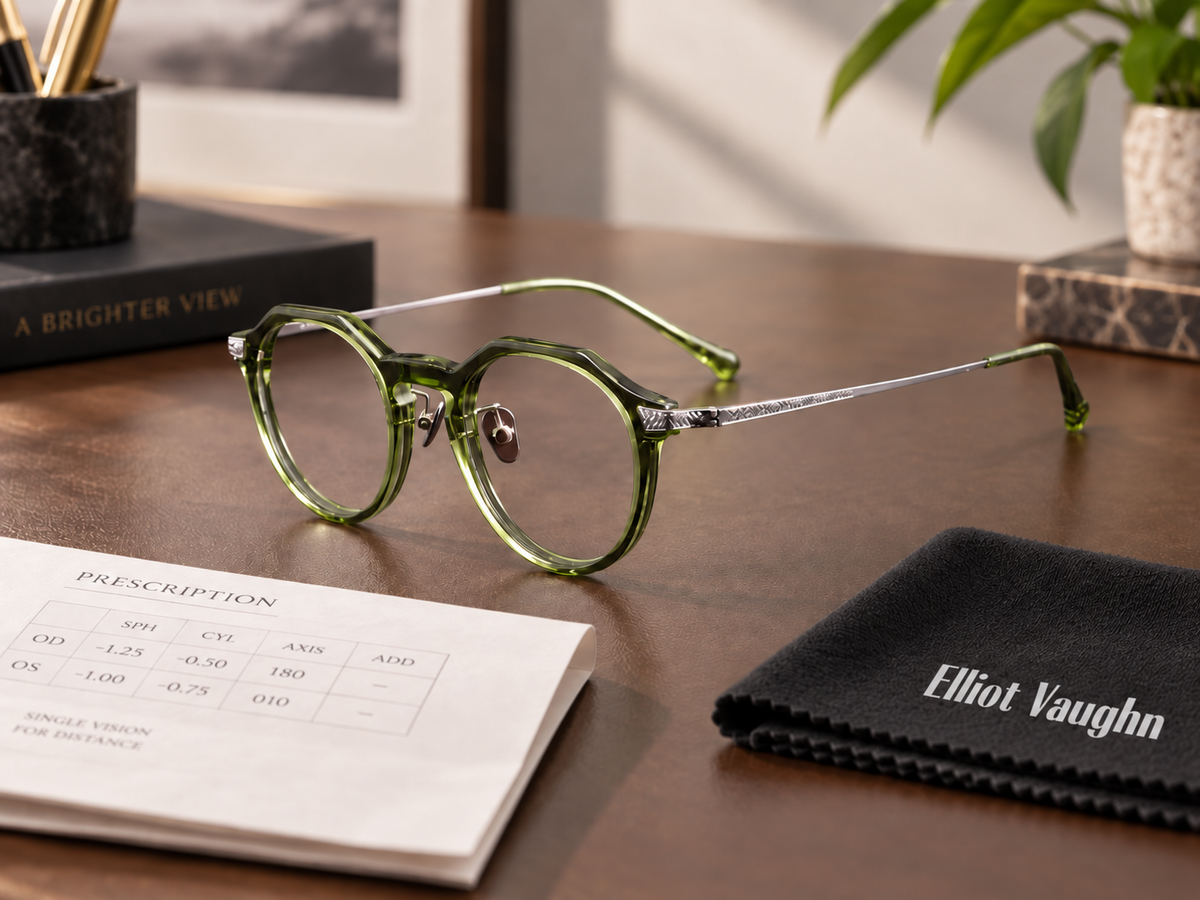
Most people choose their glasses from whatever wall their optician happens to stock. That wall is usually a few dozen frames from a small number of licensed brands, and the choice ends there.
There is another route, and it is simpler than it sounds. Buy the frame you actually want, then have an optician fit your prescription lenses into it.
Short answer: yes, you can buy glasses frames online and have prescription lenses fitted locally. Most opticians and optometrists will glaze a frame you bring in, though some charge a fitting fee or ask you to sign a waiver. You need an in-date prescription, a frame whose measurements suit both your face and your lenses, and one call to your optician before you order. Check the fit before glazing, because once new lenses are cut and fitted, the frame is no longer returnable.

What "frames only" actually means
Frames-only eyewear arrives with clear demonstration lenses fitted. They carry no prescription. Their job is to hold the frame's shape in transit and give the lab an exact template to trace when your own lenses are cut.
Separating the two makes more sense than it first appears. The lens is the medical part, and it should be specified by someone who has your prescription in front of them. The frame is the part you see, wear and live with, and it deserves to be chosen on its own terms rather than from whatever happens to be in stock.
Every frame in the Elliot Vaughn optical collection ships this way, with clear PC demo lenses fitted and ready for your optician to replace.
“New look for 2027 I'm always on the internet trying to find new looks at least once a year but once I ran across these had to have them took them to my optometrist and they'll send them out to put my prescription in love the love love the color definitely recommend them I've already got a lot of compliments on them and thanks for sending them in a timely manner" - Sarah Boyd
Before you order: three things to have ready
1. An in-date prescription
In the US, glasses prescriptions are usually valid for one to two years, depending on the state. Under the FTC's Eyeglass Rule, your eye doctor is required to give you a copy of your prescription after an eye exam, at no extra charge. If you were not handed one, ask for it.
If your last exam was more than a year ago, or your current glasses no longer feel right, book an exam before buying lenses. A new frame fitted with an outdated prescription is an expensive way to keep the same headache.
2. Your pupillary distance
Pupillary distance, or PD, is the distance between the centres of your pupils, measured in millimetres. For most adults it falls somewhere between the mid-50s and the low 70s. The lab uses it to place the optical centre of each lens directly in front of each eye.
PD is often missing from prescriptions, because the Eyeglass Rule does not require it. If you are having lenses fitted in person, your optician will measure it when you bring the frame in. You still want a rough figure before ordering, because it helps you choose a frame that will produce thinner, lighter lenses. More on that below.
3. The measurements of a pair that fits
Look inside the left temple of your current glasses. Three numbers, usually printed as something like 50□20 145, give you the lens width, bridge width and temple length of a frame you already know works. Our Sunglasses Size and Fit Guide explains each number and how much tolerance you have, and everything in it applies to optical frames too.
Choosing a frame that works with your lenses
Sunglasses tolerate a few millimetres of error. Prescription frames tolerate fewer, because every lens has an optical centre and your pupil needs to sit on it. Three checks make the difference between a frame that glazes well and one that fights your prescription.
Check the frame PD against your own
Add the lens width and the bridge width. The result is the frame PD, the distance between the geometric centres of the two lenses. A frame with a 50 mm lens and a 20 mm bridge has a frame PD of 70 mm.
If your own PD is 62 mm, the lab has to shift each optical centre 4 mm inwards. With a mild prescription that makes no practical difference. With a stronger one, the further the centres move, the thicker the outer edges become, and at the extreme the lens blank is no longer large enough to cut.
The closer the two numbers, the thinner and lighter your finished lenses. If your prescription is strong and a frame's PD is more than about 10 mm wider than yours, raise it with your optician before ordering.
Check the lens depth if you wear progressives
Progressive lenses need vertical room for three zones: distance, intermediate and reading. Most progressive designs need a lens depth of around 30 mm. Shorter-corridor designs can work in shallower frames, but with a narrower reading zone. If you wear progressives, lens height is the first measurement to check.
Match the frame to the strength of your prescription
- Strong short-sighted prescriptions (high minus) are thickest at the outer edge. Smaller lenses help, and round or oval shapes avoid the thick outer corners that rectangular lenses produce. A full-rim frame hides and protects the edge.
- Strong long-sighted prescriptions (high plus) are thickest at the centre. A smaller lens keeps the centre thinner and the lens lighter.
- Rimless and semi-rimless frames need lenses drilled or grooved to hold them, and they suit milder prescriptions best.
Recommended for stronger prescriptions
A round titanium frame with a full rim. The continuous curve avoids the thick outer corners of a rectangular lens, and titanium keeps the frame light enough to offset the added weight of a stronger prescription.

Look for adjustable nose pads
A frame you wear from morning to night has to sit at exactly the right height, and it has to stay there. Individually mounted nose pads can be set by your optician when your lenses are fitted, raising the frame off the cheeks or narrowing it to stop a slide. On a fixed bridge, what you receive is what you get.
Recommended for an adjustable everyday fit
Titanium construction with a layered full-rim front and a soft polygon silhouette with subtly raised corners. Individually mounted nose pads and a curved bridge let your optician set the fit precisely when the lenses go in, and slender temples keep the side profile light.

Titanium, acetate or metal
| Material | Strengths | Trade-offs |
|---|---|---|
| Titanium | Very light for its strength, resists corrosion from moisture and perspiration, allows fine profiles, holds an adjustment well | Less scope for deep colour and pattern |
| Acetate | Rich colour, depth and pattern, a warm substantial feel | Heavier, and usually a fixed bridge |
| Stainless and other metals | Slim profiles and adjustable pads | Heavier than titanium |
For glasses you wear all day, weight matters more than it does for sunglasses you wear for an afternoon. That is the case for titanium, and it is why most of the Elliot Vaughn optical collection is built in it. Strength without bulk means a frame can be fine without being fragile, and the lightness shows by evening.
Choosing a shape
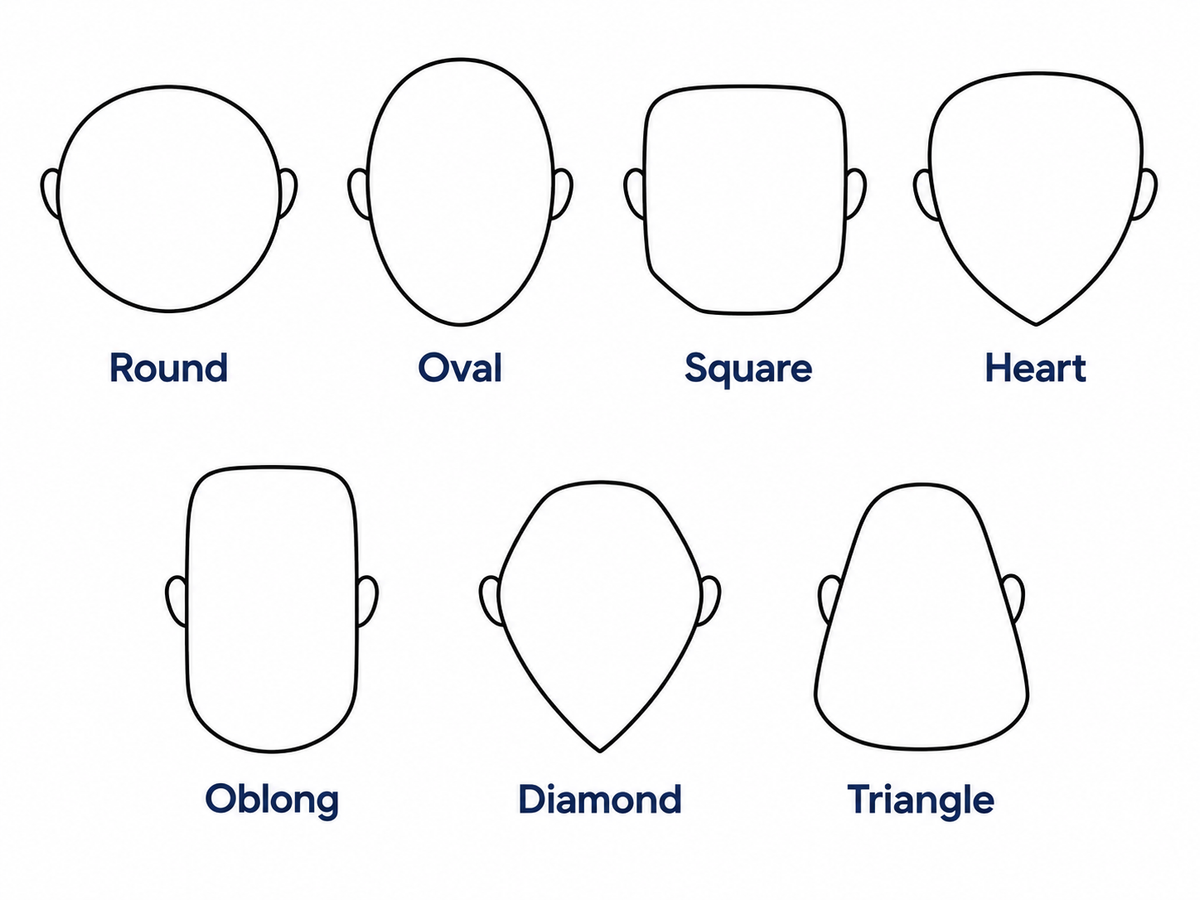
The same principle that governs sunglasses applies to optical frames: a frame flatters by contrast. Angular faces soften under curved frames, and softer faces gain definition from angular ones. Our guide to choosing eyewear for your face shape covers all seven face shapes in detail. As a starting point:
| Face shape | Look for | From the optical collection |
|---|---|---|
| Round | Angular or geometric lines | Moreau Geometric, Hadley Titanium |
| Square | Round and oval curves | Elian Round Titanium, Montrose Round, Colette Oval |
| Heart and diamond | Lift at the outer corners, or soft ovals | Solène Cat-Eye, Colette Oval |
| Oval | Most shapes, in proportion | The full optical collection |
Recommended for heart and diamond faces
A cat-eye optical frame with a measured lift at the outer corners, which widens the upper third of the face and balances a narrower chin. Enough shape to register through clear lenses without overstating it.

When the frame arrives: check the fit before glazing
This is the step most people skip, and it is the one that protects you.
Try the frame on at home with the demo lenses still fitted. Work through the seven fit checks in the Size and Fit Guide: width at the hinges, eye position in the lens, brow line, cheeks, temples, ears and the nod test. For optical frames, pay particular attention to eye position. Your pupils should sit roughly centred left to right in each lens.
If something is wrong, return it now. A frame fitted with new prescription lenses is no longer in its original condition, and neither we nor most retailers can accept it back.
Five questions to ask your optician
Call before you order the frame, not after. It takes five minutes and removes every surprise.
- Do you fit lenses into frames bought elsewhere? Most practices do. A few do not, particularly if they are tied to a chain.
- Is there a fitting fee, and will you ask me to sign a waiver? Some practices charge for handling customer-supplied frames, and some ask you to accept the small risk of damage during glazing.
- Is the work done in-house or sent to a lab? In-house glazing can take days. Sending out can take one to two weeks.
- Which lens material and index do you recommend for this frame? Tell them the frame's measurements and material. A good optician will factor both into the recommendation.
- Will you adjust the fit when I collect them? Pad and temple adjustment should be part of the service. It is the difference between a frame that fits and one that merely holds lenses.
Lens prices vary widely with type, material, index and coatings. Ask for a quote on lenses alone, with the coatings you actually want, before you commit.
If you would rather not visit a practice, online lens replacement services will glaze a frame you mail to them. The same questions apply, and you will need your PD in writing.
Can sunglasses take prescription lenses too?
Often, yes. Many full-rim sunglasses frames can be fitted with prescription lenses by an optician, including tinted and polarized options. The limiting factor is wrap: the more a frame curves around the face, the narrower the range of prescriptions it can accept without distortion. Flatter fronts, like most aviators and classic square shapes, are the easiest to glaze.
If you are considering it, take the frame's measurements to your optician and ask before ordering. Browse polarized sunglasses, men's sunglasses and women's sunglasses.
Frequently asked questions
Can I buy glasses frames online and take them to an optician? Yes. Most opticians and optometrists will fit prescription lenses into a frame you supply. Call ahead to confirm, and ask about fees and turnaround.
What are demo lenses? Clear, non-prescription lenses fitted to a frame at the factory. They hold the frame's shape and give the lab a template to trace. Your optician removes them when your prescription lenses are fitted.
Do I need my PD to buy frames online? Not strictly, if an optician is fitting your lenses in person, since they will measure it. It is still worth knowing, because comparing your PD to the frame PD tells you whether a frame suits your prescription before you order it.
Can I get progressive lenses in frames bought online? Yes, provided the lens is deep enough. Most progressive designs need around 30 mm of lens height. Check the frame's measurements and confirm with your optician.
Can I return a frame after lenses have been fitted? Generally no, because the frame is no longer in its original condition. Check the fit with the demo lenses in place and decide within the return window before you have it glazed.
Is titanium worth it for glasses? For frames you wear all day, usually yes. Titanium is light for its strength and resists corrosion from perspiration, which means a finer frame that stays comfortable and keeps its finish.
Every Elliot Vaughn optical frame ships with clear demo lenses fitted, in a turquoise hard case with a microfiber cloth, and returns stay open for 30 days so you can check the fit before your lenses go in. Browse the optical eyewear collection.

Leave a comment
This site is protected by hCaptcha and the hCaptcha Privacy Policy and Terms of Service apply.