

The advice usually arrives as a list of rules, and the rules usually contradict each other. Here is the principle underneath all of them, which is easier to remember and harder to get wrong:
A frame flatters by contrast. Angular faces soften under curved frames. Soft, rounded faces gain definition from angular ones. Long faces look shorter behind a deep frame, and wide faces look narrower behind a frame with a strong horizontal line.
That single idea covers about eighty per cent of the decision. The remaining twenty per cent is size, which is a separate matter and is dealt with at the end of this page.

First, work out your face shape
Most people guess this wrong, usually by one step. Two minutes with a mirror settles it.
The quick method
Pull your hair back, face a mirror straight on, and trace the outline of your face on the glass with a bar of soap or a dry-wipe marker. Step back. The shape on the mirror is your face shape, without the interference of hair, glasses or expression.
The measured method
More reliable, and worth doing if the traced outline sits between two shapes. Take four measurements with a soft tape:
- Forehead width at its widest point, roughly halfway between your brows and your hairline
- Cheekbone width across the top of the cheekbones, from one outer eye corner to the other and slightly beyond
- Jaw width across the jaw at its widest point, below the ears
- Face length from hairline to the base of the chin
Then read the pattern:
| Face shape | How the numbers fall | The giveaway |
|---|---|---|
| Oval | Length clearly greater than cheekbone width; cheekbones widest; forehead wider than jaw | Gentle taper from cheek to chin |
| Round | Length and cheekbone width close; cheekbones widest | No hard angle anywhere along the jaw |
| Square | Length and width close; forehead, cheekbones and jaw within a few millimetres | A defined, angular jaw corner |
| Oblong | Length clearly greater than width; forehead, cheekbones and jaw close in width | Long and straight-sided |
| Heart | Forehead widest; jaw narrowest | A narrow, pointed chin |
| Diamond | Cheekbones widest; forehead and jaw both narrow | High, prominent cheekbones |
| Triangle | Jaw widest; forehead narrowest | Weight sits in the lower third |
If two shapes seem close, use the jaw. An angular jaw corner puts you in square or oblong. A continuous curve puts you in round or oval.
Round faces
How to recognise it: width and length are close, cheekbones are the widest point, and the jaw curves without a corner.
What works: angular frames. Square, rectangular and sharply drawn cat-eye shapes introduce the straight lines the face does not have, and a strong horizontal brow line across the top of the frame makes the face read as longer. Frames that are wider than they are tall work in your favour.
What to avoid: small round frames, which repeat the curve and emphasise it. Round frames can work if they are large and boldly drawn, but it is the harder route.
Recommended for round faces
A square front with clean corners and a flat upper line, which is the detail that does the work here. The straight brow line adds the definition a round face lacks, and the width keeps the proportions balanced rather than heavy.

Browse more in square sunglasses for men and square sunglasses for women.
Oval faces
How to recognise it: the face is noticeably longer than it is wide, the cheekbones are the widest point, and the line from cheek to chin tapers gently.
What works: almost everything, which is the reason oval is treated as the reference shape. Aviators, squares, rounds and cat-eyes all sit well. The one thing worth watching is proportion: a frame that is much wider than your cheekbones will unbalance a face that is already balanced.
What to avoid: oversized frames that swamp the middle of the face, and very small frames that leave too much visible around them.
Recommended for oval faces
A stainless-steel aviator with polarized UV400 lenses and adjustable silicone nose pads, at 22 g. The teardrop follows the natural taper of an oval face, and the adjustable bridge lets you set the height precisely rather than accept it.

Square faces
How to recognise it: length and width are close, the forehead, cheekbones and jaw are similar in width, and the jaw has a defined corner.
What works: curves. Round and oval frames soften the angles, and a frame with a rounded upper edge takes the hardness out of a strong brow. Thin metal frames do this more gently than heavy acetate.
What to avoid: square frames with sharp corners, which repeat the jaw line and can make the face look severe. Very heavy, wide frames add weight where there is already structure.
Recommended for square faces
A round frame with oval lenses, drawn in a restrained unisex profile. The curve runs continuously with no corner to echo the jaw, which is exactly the contrast a square face is looking for.

The Celestine Round is the lighter metal alternative if you want the same softening in a slimmer build.
Heart-shaped faces
How to recognise it: the forehead is the widest point, the cheekbones are close behind it, and the chin narrows to a point.
What works: frames that carry visual weight low, or carry very little weight at all. Aviators are the standard answer, because the teardrop tapers downward in the same direction the face does. Rimless and light metal frames also work, since they avoid stacking width across an already wide forehead.
What to avoid: heavy top bars, thick upper rims and anything that widens the top third of the face further.
Recommended for heart-shaped faces
The tapered aviator line draws the eye downward and gives the narrow chin something to balance against. Slim metal keeps the upper edge light, so the width of the brow is not repeated at frame level.

If you prefer to remove the upper line entirely, the Carrington Rimless does that.
Oblong faces
How to recognise it: the face is clearly longer than it is wide, with forehead, cheekbones and jaw close in width and a straight-sided profile.
What works: depth. A frame with tall lenses covers more of the face's vertical span and shortens it visually. Width helps too, as does a decorative or contrasting temple, which draws the eye sideways. Oversized frames suit this shape better than any other.
What to avoid: narrow, shallow frames. A slim rectangular lens sitting in the middle of a long face divides it into thirds and lengthens it further.
Recommended for oblong faces
A large transparent frame with gradient lenses and enough lens height to shorten a long face rather than divide it. The translucent front keeps the scale from reading as heavy.

Diamond faces
How to recognise it: the cheekbones are the widest point by a clear margin, with both the forehead and the jaw noticeably narrower, and the chin coming to a point.
What works: frames with detail or lift along the top edge, which brings width back to the forehead and balances the cheekbones. Cat-eyes do this well. Oval frames and rimless styles work by softening the cheekbone line instead.
What to avoid: narrow frames that sit inside the cheekbone width, which exaggerate the widest part of the face.
Recommended for diamond faces
Sculpted lower rims and a polished metal brow detail put the emphasis along the top edge, where a diamond face needs it. The outer corners lift just enough to widen the upper third without overstating the shape.

More options in cat-eye sunglasses.
Triangle faces
How to recognise it: the jaw is the widest point and the forehead is the narrowest. Sometimes called a pear shape.
What works: the reverse of the heart-shape advice. Frames with presence along the top, a defined brow line, or a stronger upper rim add width to the narrow forehead and balance the jaw. Cat-eyes and browline frames both do this.
What to avoid: bottom-heavy frames and anything that adds width at the level of the jaw.
Recommended for triangle faces
The upswept outer corners put the emphasis along the top edge, which adds width to a narrow forehead and balances a stronger jaw. Enough lift to do the work without overstating the shape.

Where face shape stops mattering
Face shape decides which frame shapes are worth trying. It does not decide whether a specific frame will fit, and this is the point most guides skip.
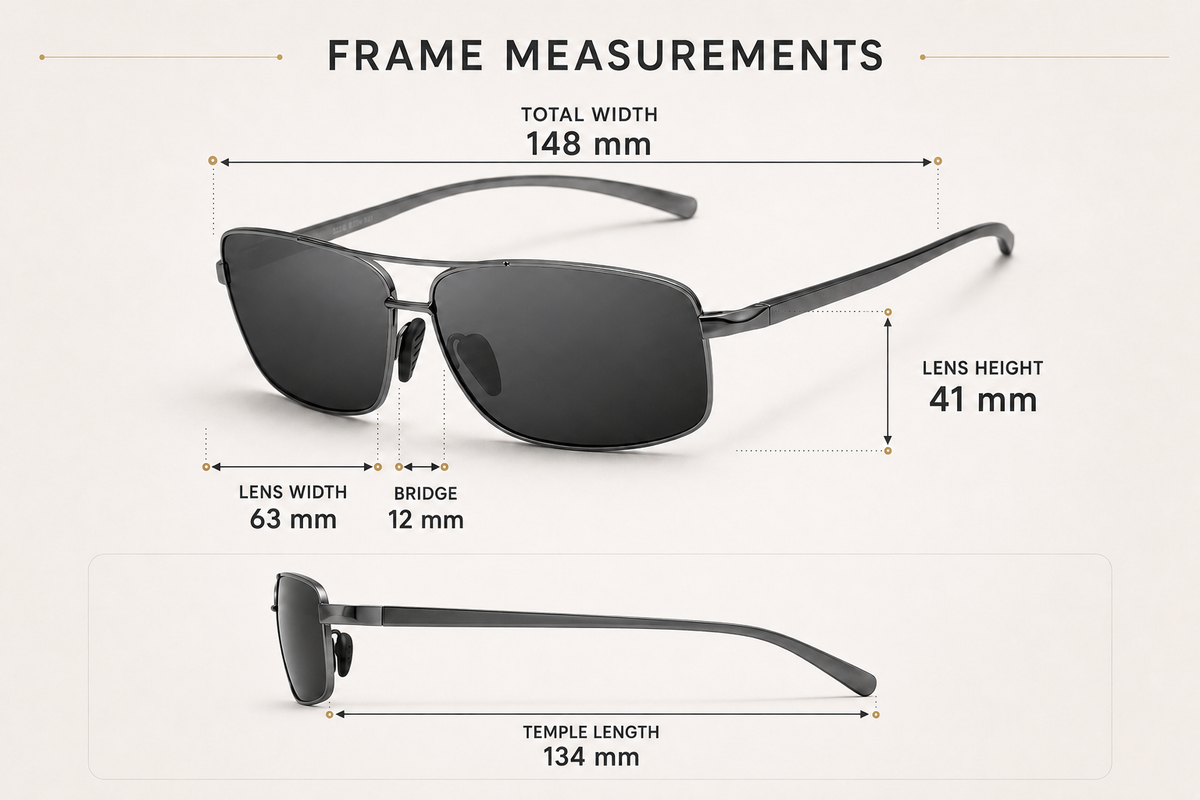
A frame in exactly the right shape will still look wrong if the front is 10 mm too wide, if the bridge sits too low and drops the lenses onto your cheeks, or if the temples are too short and push the whole frame forward. Size problems are more common than shape problems, and they are more obvious to everyone else.
Two things beat face shape in order of importance:
- Total frame width should be close to the width of your face at the temples
- Bridge fit should hold the frame at the right height without sliding
Both are covered in detail in the Sunglasses Size and Fit Guide, which is worth reading before ordering anything.
The other honest caveat: face shape categories are approximations. Plenty of faces sit between two of them, and the answer there is simply to try both directions. If a frame looks right to you in the mirror, it is right, whatever the chart says.
Does this change for glasses?
The shape logic is identical. A round face still benefits from an angular frame whether the lenses are tinted or clear.
Three things do change with optical frames:
- They are worn constantly, so a frame you find slightly heavy in a shop will become genuinely uncomfortable by the afternoon. Titanium and thin metal are worth the attention here.
- Proportion is more visible. People see your eyes through clear lenses, so the frame sits in direct relationship with your features rather than covering them. Errors of scale show more.
- Lens height has a functional role. If you wear progressives, the lens needs vertical room for the distance, intermediate and reading zones, which rules out very shallow frames regardless of what suits your face.
Recommended in optical
A round optical frame in a range of finishes, cut to soften an angular jaw or a strong brow. Supplied as a frame with clear demo lenses fitted, ready for your own optician to glaze to prescription.

The full optical eyewear collection covers round and titanium builds. All optical frames are sold as frames only, with clear demo lenses fitted, so prescription lenses are arranged through your own optician.
Frequently asked questions
How do I know my face shape? Trace the outline of your face on a mirror with your hair pulled back, then compare the shape to the seven outlines above. If it sits between two, measure your forehead, cheekbones, jaw and face length and read the pattern rather than the outline.
What sunglasses suit a round face? Angular frames. Square and rectangular shapes, and cat-eyes with a defined upward line, add the definition a round face does not have on its own. A straight upper brow line across the frame is the single most useful detail.
What sunglasses suit a square face? Curved frames. Round and oval shapes soften a strong jaw, and slim metal does this more gently than heavy acetate.
Do aviators suit everyone? No, though they suit more faces than most shapes do. They work particularly well on oval and heart-shaped faces, where the downward taper follows the line of the face. On a round face they can soften an already soft outline.
Can I wear a frame that does not match my face shape? Yes. These are guidelines for balance, not rules. A frame that is deliberately at odds with your face shape can look considered rather than wrong, provided the size is right.
Does face shape matter more than frame size? No. Size matters more. A frame in the right shape and the wrong size looks worse than a frame in the wrong shape and the right size.
Browse the full range in men's sunglasses, women's sunglasses and optical eyewear. Every order ships in a turquoise hard case with a microfiber cloth, and returns stay open for 30 days.


Leave a comment
This site is protected by hCaptcha and the hCaptcha Privacy Policy and Terms of Service apply.